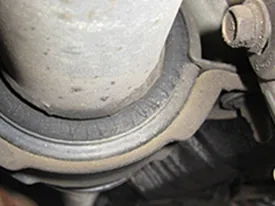
 Fix first
Drive shaft loose
Mid shaft bearing rubber worn out, bad, drive shaft loose.
Buying in Baltimore, the DC suburbs, the Eastern Shore or out west in Cumberland? We book an independent inspector who checks the car where it is and writes up what they find, with photos. Maryland is one of the few states that makes a used car pass a safety inspection before the MVA will title it, so learn what the car needs to pass before you pay, not after.
By Auto InspectorsUpdated
| Safety inspection to title | Required for any used vehicle except historic (Class L) |
|---|---|
| Inspection certificate valid | 90 days (dealer inventory: 6 months or 1,000 miles) |
| Temporary registration | Car must be inspected within 60 days |
| Excise (titling) tax | 6.5% of the price, $100 minimum |
| Late title application | Extra service fee possible after 30 days |
| Salvage threshold | Repairs over 75% of fair market value |
| Salvage inspection | Maryland State Police, $75 fee |
| As-is sales by dealers | Only for cars over 6 model years old and over 60,000 miles |
Our inspectors work across the whole state. Pick your area, or just enter the ZIP code where the car is in the form.
Not on the list? We still cover it. Every ZIP code in Maryland is in our area.
The Motor Vehicle Administration handles titles and tags. The law tells the buyer to apply promptly, and if the MVA doesn't get the title and application within 30 days of delivery, it can add a service fee.
You pay the excise tax when you title. Since July 2025 it is 6.5% of the price, up from 6%, with a $100 minimum. If you already paid at least 6.5% to another state when you lived there, you usually pay the $100 minimum; otherwise you pay the difference.
Dealers take care of the paperwork and the inspection. In a private sale both fall to you, and the inspection is the step that surprises people.
Before the MVA titles and registers any used vehicle, except a historic one, it needs a valid Maryland inspection certificate from a licensed station overseen by the State Police. The certificate is valid for 90 days. If the car changes hands again within 30 days of an inspection, no new one is needed. The MVA can also issue temporary registration and hold the title, but the car must then pass inspection within 60 days.
Separately, most of the state's urban and suburban counties are in the VEIP emissions program, which tests cars on a regular schedule after they're registered.
Here is the catch for private buyers: many sellers list cars without a current certificate, and the repairs to pass can run into real money. Tires, brakes, exhaust leaks, cracked windshields and rust holes all fail. A pre-purchase inspection shows those items before you agree on a price. It also covers what the state check skips, like engine and transmission condition and prior crash repair.
Cars coming from other states. The same inspection rule applies to a car brought in from out of state: no certificate, no Maryland title. New residents need a valid Maryland safety inspection to title and register. Buyers in Montgomery and Prince George's often shop in Virginia and DC, and Cecil County buyers in Delaware and Pennsylvania. Check before you buy that the car will pass here. Our out-of-state guide covers the rest.
Salvage, rebuilt and flood titles. An insurer must get a salvage certificate when repair costs are more than 75% of the car's fair market value. After repair, Maryland titles may read rebuilt salvage or Flood Damaged, and an X-Salvage brand marks a car that is not to be rebuilt.
To retitle a salvage car, the owner books a Maryland State Police salvage inspection, $75. The trooper checks the VIN and looks for stolen parts, and on a pass embosses the salvage certificate. The owner then gets a title and a 30-day temporary registration to pass the regular safety inspection.
Maryland law stops dealers from excluding implied warranties on most used cars. A dealer can sell as is only when the car is more than 6 model years old and has more than 60,000 miles, and the dealer must give notice on the state form. On a newer or lower-mileage car, the implied warranty of merchantability applies whatever the paperwork says.
Private sellers can sell as is. That is the main gap: a three-year-old car bought from a neighbor carries none of the dealer protection. See as-is and warranties for the federal Buyers Guide.
Maryland salts heavily on I-70, I-68 and I-83, and Garrett and Allegany counties get real snow. Cars from western Maryland often have rusted brake lines and subframes. Inspectors look under the car with a light and a mirror.
Flash floods are the other risk. Ellicott City's Main Street flooded in July 2016 and again in May 2018, with cars swept down the street. Annapolis and the Eastern Shore see tidal flooding, and Baltimore's potholes go hard on tires, wheels and suspension. Commuter cars from the Beltway corridor often carry high, stop-and-go miles.
Copart and IAA run salvage yards around Baltimore. Manheim's Baltimore-Washington sale in Elkridge is dealer-only. Remember that any salvage car still needs the State Police salvage inspection and a safety inspection before it can be driven legally. Read what you can inspect at auction.
Give us the car's address and the listing link. The inspector meets the car wherever it's parked, follows the checklist and sends you the photo report. We cover all of Maryland: Baltimore, the Washington, DC suburbs in Montgomery and Prince George's, Annapolis, Frederick, Hagerstown, Salisbury, Cumberland and Waldorf.
Mobile inspections are commonly listed around $210 to $449 depending on the vehicle; a basic shop inspection often runs $100 to $200. You get a quote before anything is booked.
Booking an inspection in Maryland takes a few minutes. The inspector does the rest.
Where it is, what it is and who is selling it. A link to the listing helps.
A local inspector confirms the price and the visit with you, and with the seller if you want.
Body and paint, underneath, under the hood, a computer scan and a road test where the seller allows it.
A written report with photos, and a call to talk it through before you pay for the car.
Every system gets a plain verdict, with photos of anything that needs attention. Below the example are real faults found on other inspections.
Fix firstMid shaft bearing rubber worn out, bad, drive shaft loose.
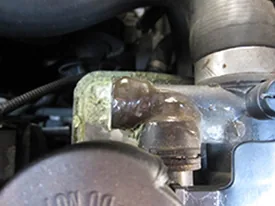 Fix first
Radiator broken, repaired, and still leaking antifreeze.
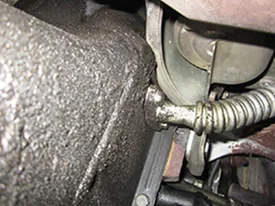 Watch
Turbo oil return line, leaking oil at gasket, front and rear turbos.
Letters from customers of ACE Auto Inspectors, the Metro Atlanta mobile inspection service this site grew out of.
My inspection experience with Ron & Nan was very informative. Ron is very knowledgeable in the auto industry, he fine tunes all facets of the vehicle, body, mechanical, paint, etc.
I encountered another individual that has also offered his assistance. His name is Ron Brinson and he owns Ace Auto Inspectors. I have used Ron to inspect used vehicles for me in the past and he has always done an excellent job. […]
Buying across the state line? Each page covers that state's title, inspection and warranty rules.
You need one to title it. The MVA won't title a used vehicle without a valid Maryland safety inspection certificate, which is good for 90 days. Who pays for it is up to you and the seller.
The MVA can issue temporary registration and hold the title, but the car must pass inspection within 60 days.
6.5% of the price since July 2025, with a $100 minimum. Credit may apply for tax paid to another state.
Only if the car is more than 6 model years old and has more than 60,000 miles, with notice on the state form. Otherwise implied warranties apply.
The Maryland State Police, for a $75 fee. They check VINs and parts for theft, not the quality of the repair.
What an inspection can't do. An inspection reports what can be seen and tested on the day, without taking the car apart. It can't promise that nothing will fail later, and it is not a warranty. Hidden frame repairs, intermittent faults and wear inside the engine or gearbox may not show.